
Prepare the compound
Select the polymer grade, additives and precursor geometry. Record the batch, reference dimensions and the material conditioning needed for a reproducible sample.
Physical N2 foaming. Purposeful sole geometry.
A development route built around your footwear brief.
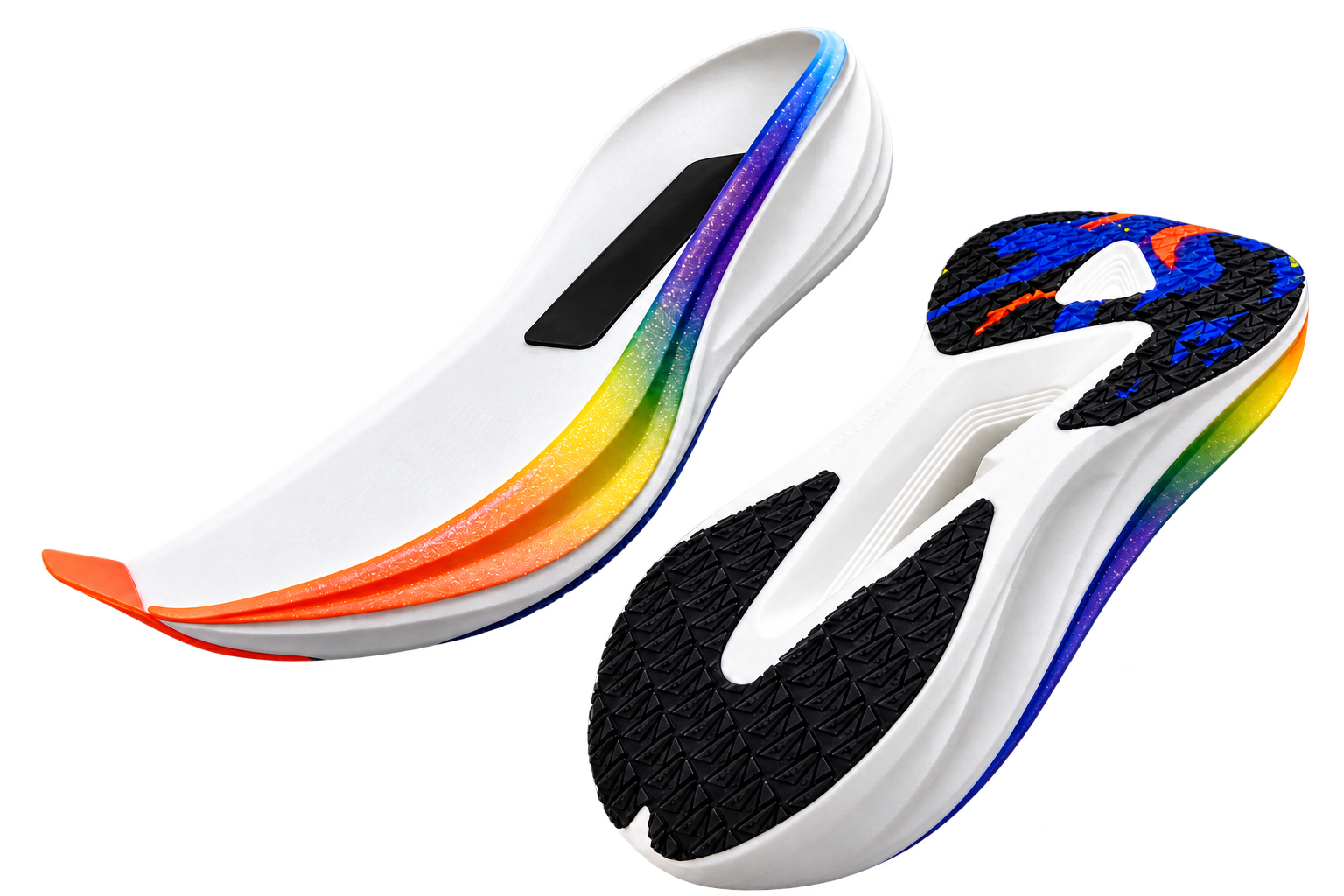
Supercritical foaming uses a physical gas under controlled temperature and pressure to create a cellular structure within a polymer. Nitrogen and carbon dioxide are used in different physical-foaming routes; Easteed’s development brief focuses on the proposed N2 route, compound and sole design.
The process name does not identify the resin, finished density or rebound of a particular sample. Those outcomes depend on the formulation, processing window, cell structure, geometry and the way the sole is assembled and tested.
Process background: EVA physical-foaming study ↗
The sequence below explains the general mechanism. The actual recipe, tooling and operating conditions are agreed for the selected material and project.
Select the polymer grade, additives and precursor geometry. Record the batch, reference dimensions and the material conditioning needed for a reproducible sample.
Under the selected temperature and pressure, gas enters the polymer. Saturation time and the material’s gas uptake are part of the process window.
A controlled change in conditions initiates cell nucleation and growth. Expansion and cell stability depend on the compound and pressure–temperature history.
Allow the component to stabilise, then check dimensions and density before trimming, surface preparation or assembly. Connect every result to its sample version.
Conceptual process diagram. No equipment ownership, production recipe or sample test result is represented.
Start from the application and evaluation criteria. A polymer family is a discussion point, not a complete specification or confirmation that a supplied reference uses that material.
| Material family | Development perspective | What to review |
|---|---|---|
| EVAEthylene–vinyl acetate | A familiar starting point for molded cushioning. The resin blend and network structure matter alongside the physical-foaming conditions. | Balance density, hardness, dimensional stability and long-term compression behaviour. |
| TPUThermoplastic polyurethane | Different grades and processing routes can support different midsole concepts. Bead foaming, autoclave foaming and SCF injection are distinct routes rather than interchangeable labels. | Confirm the grade, route, assembly method and durability requirements together. |
| PEBAPolyether block amide | A material family considered where low weight and dynamic response are priorities. Hardness, flexibility and temperature response depend on the selected grade. | Review resin suitability, geometry, bonding and the performance–cost target before committing. |
Material background: BASF TPU processing routes ↗ · Arkema PEBA properties ↗. These are technical references, not a statement of a supply relationship or the compound in the displayed samples.
A closer look across the supplied sole references: sidewall geometry, color transitions, ground-contact layouts and the interface between components. Choose a series to bring it into focus.
Review stack, base width, toe transition, flex zones and the upper interface around a nominated reference size. A change in geometry may affect support and perceived cushioning even with the same compound.
Define rubber coverage, surface preparation and bond-line requirements. Outsole abrasion, traction and adhesion answer different questions and should be assessed with the intended use in mind.
If a plate is part of the brief, agree its material, position and stiffness target. Inspect fit and assembly integrity; a dark insert in a photograph does not establish a verified carbon-fibre specification.
A rebound percentage or hardness value is only meaningful with its test method, specimen and conditions. Define the acceptance criteria before comparing results.
Record the compound, batch, sample version, reference size, mass and dimensional tolerances.
Agree density, hardness, compression response and recovery checks. Record conditioning and the complete test method.
Review flexing, compression set, outsole wear and bond integrity for the intended construction.
Use component findings alongside complete-shoe fit and wear evaluation. Approve a traceable sample and specification before scaling.
No. It describes a processing direction. EVA, TPU and PEBA are different polymer families, and the exact grade and formulation still need to be identified.
Only when the specimen, method, conditioning and test settings are comparable. A component result is also different from a complete-footwear performance claim.
The supplied images are development references. Material identity, geometry, size range, tooling access, MOQ and delivery conditions are confirmed for the actual project.
Share the intended application, a reference or drawing, target size range, quantity, timing and the main question you want the sample to answer. We can clarify the remaining details together.