

Describe the product and its user
A strong brief makes the next decision easier. Begin with the shoe’s primary use: road running, court sports, field sports, trail and hiking, or everyday wear. Add the relevant age group and size range as separate information. A junior basketball programme, for example, belongs to a court application while retaining its own fit and size requirements.
Explain the target wearer, intended market and sales channel in plain language. State the ground conditions and typical use, then identify the most important priorities. Avoid requesting the lightest, softest, most durable and lowest-cost construction without ranking them. A short order of priorities gives the development team a basis for proposing alternatives.
Separate references from requirements
Attach images or archive reference IDs with a note on what each reference demonstrates. One may show a sidewall treatment; another may communicate outsole coverage. Explain what should change as well as what should remain. A reference photograph does not establish its polymer, hardness, tooling ownership or suitability for your last.
Provide the last or available dimensions, the nominated sample size and the intended upper construction. Mark unknowns explicitly. If a complete technical package is not yet available, ask for a feasibility review and a list of required inputs. This is more productive than presenting an attractive rendering as though it were a finished manufacturing specification.
Make the request easy to quote
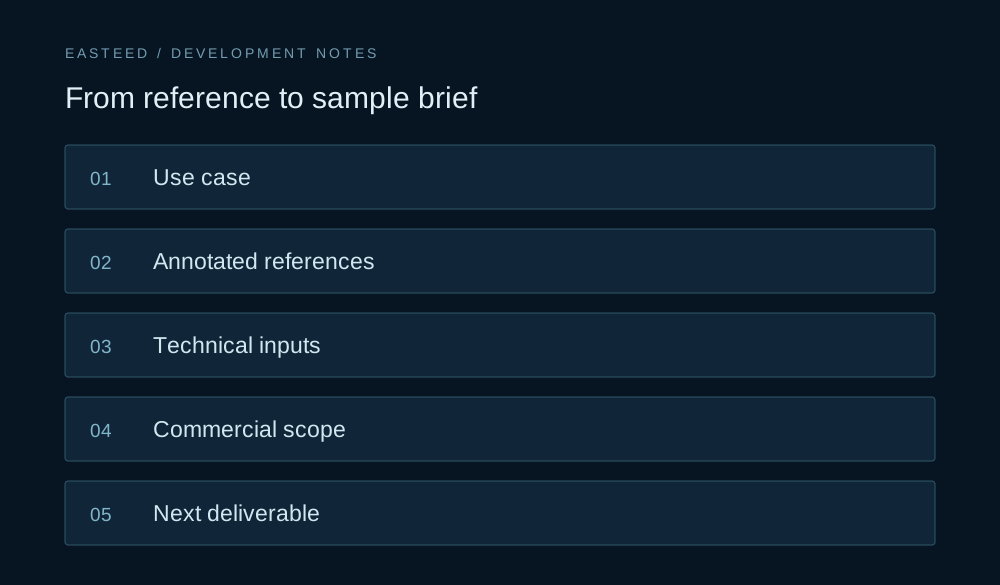
Use one brief document rather than asking a supplier to reconstruct requirements from several message threads. A compact first page can identify the product, application, target wearer, sample size, reference IDs and decision owner. A second page can hold annotated views and a table of open questions. Put the revision date and project name on both. The format can remain simple as long as the current instruction is unmistakable.
For the commercial section, distinguish a target from a commitment. State whether the quantity is a development estimate or a confirmed order plan, whether pricing is requested for components or finished footwear, and which currency and delivery basis should be used. Identify tooling, sampling, testing and packaging costs separately. These instructions help make quotations comparable without assuming that every supplier has interpreted the request the same way.
The expected response should include a proposed scope, feasibility concerns, missing inputs, a sample plan and the basis of any cost or timing estimate. Ask the supplier to identify the decision that must be made before each next stage. This gives procurement and product development a shared document to review instead of two different versions of the project.
Define evidence and commercial boundaries
List the claims the finished product is expected to make and identify how they will be supported. For grip, include the intended surface and conditions. For durability, describe the relevant failure concerns and expected use. SATRA’s friction method covers different floors and contaminants, which reinforces the need to specify the test context rather than ask for “good grip” in isolation.
Provide indicative quantity, size distribution, color count, target cost basis and the desired launch sequence. Distinguish sample timing, tooling timing and production timing. Ask the supplier to state what is included in the quotation, which assumptions affect it and when those assumptions need to be confirmed. Unconfirmed quantities or artwork should remain visible as open items.
Agree how decisions will be recorded
Nominate the people who can approve appearance, fit, testing and commercial changes. Give each sample a revision ID and use a shared change log. Record the reason for each change, its expected effect and the evidence needed to accept it. When several departments review the same sample, a single consolidated response reduces conflicting instructions.
End the brief with the next deliverable: a feasibility response, a material proposal, a prototype or a formal quotation. State what the supplier should return and what decision it will support. After each review, update the brief itself so the project does not depend on scattered messages.
For a first conversation with Easteed, send your application, reference IDs, size range, target market and the three priorities that matter most. The aim is not to fill every field immediately. It is to establish a clear starting point, expose uncertainties early and make the first sample round useful.
Sources & further reading
This article combines the cited technical context with Easteed editorial recommendations for project planning. It does not claim that Easteed uses the cited branded materials, holds a certification or has tested the illustrated reference.
Bring a reference.
Define the next decision.
Share the application, available drawings and the question your next sample needs to answer.
Build a project brief ↗